30-Day Civil Service Exam Study Plan: How to Prepare Effectively
Follow this practical 30-day Civil Service Exam study plan to review the official coverage, strengthen weak areas, take timed practice tests, and prepare for exam day.
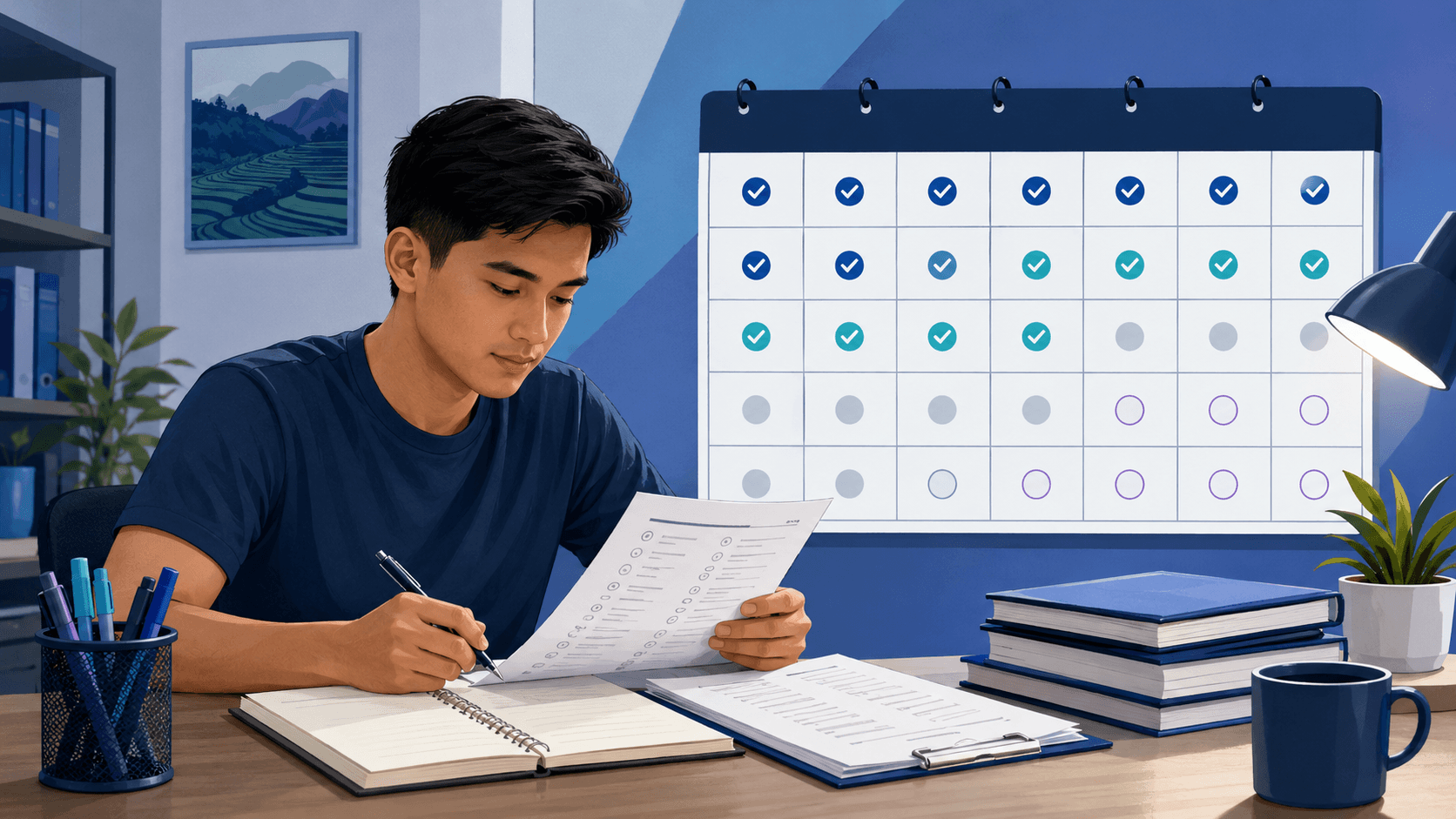
Preparing for the Civil Service Exam in only one month is challenging, but it is manageable when every study session has a clear purpose. A focused 30-day Civil Service Exam study plan can help you understand the coverage, identify weak areas, practise under time pressure, and avoid spending too much time on topics you already know.
The goal is not to study every possible question. Instead, you should build the skills needed to answer unfamiliar questions accurately and efficiently. This plan is suitable for both Professional and Subprofessional examinees, including working applicants who can study for only one or two hours on weekdays.
What the Civil Service Exam covers
Before opening a CSE reviewer, make sure your materials match the official examination coverage. Based on the Civil Service Commission’s 2026 examination announcement, both levels include General Information, Verbal Ability, and Numerical Ability.
General Information covers:
- The Philippine Constitution
- Republic Act No. 6713, or the Code of Conduct and Ethical Standards for Public Officials and Employees
- Peace and human rights issues and concepts
- Environmental management and protection
Verbal Ability is tested in English and Filipino. It includes word meaning, sentence completion, error recognition, sentence structure, paragraph organization, and reading comprehension.
Numerical Ability includes basic operations, number sequences, and word problems. Calculators are not allowed during the CSE-PPT, so your preparation should include solving calculations manually.
The main difference between the levels is another ability area:
- The Professional level includes Analytical Ability, covering analogy, abstract reasoning, assumptions, conclusions, and data interpretation.
- The Subprofessional level includes Clerical Ability, particularly filing and spelling.
The CSC requires a general rating of at least 80.00 to pass. This does not mean you should aim for exactly 80 percent in every practice session. A safer study target is to improve both your accuracy and your ability to complete questions within the available time.
You can review the official details in the CSC 2026 CSE-PPT examination announcement.
RevView is an independent reviewer and is not affiliated with, endorsed by, or accredited by the Civil Service Commission.
Before starting your 30-day Civil Service Exam study plan
Begin with a diagnostic test covering the major ability areas. A diagnostic test is not primarily meant to produce a high score. It shows which topics deserve the most attention.
After taking the test, classify each incorrect answer:
- You did not understand the concept.
- You understood the concept but made a calculation or reading error.
- You spent too much time on the question.
- You guessed without eliminating choices.
- You misread an English or Filipino word.
- You forgot an important rule or fact.
Record the results in a notebook or digital document. For each topic, write your score, the mistakes you made, and what you need to review. This error log will become more valuable than repeatedly reading an entire reviewer from beginning to end.
You should also decide on a realistic daily schedule. One focused hour is usually more useful than three distracted hours. If you work during the day, consider studying for 60 to 90 minutes on weekdays and scheduling longer practice sessions on weekends.
Days 1 to 7: Build your foundation
The first week is for understanding the exam and strengthening essential skills.
Day 1: Take a diagnostic test
Complete a mixed set of questions without checking the answers while working. Use a timer and mark questions you are unsure about. Afterwards, review every mistake and identify your three weakest areas.
Day 2: Review basic numerical operations
Practise addition, subtraction, multiplication, division, fractions, decimals, percentages, ratios, and averages. Solve without a calculator because calculators and other answering aids are prohibited during the CSE-PPT.
Focus on accuracy first. Once your process is reliable, begin reducing the time required for each calculation.
Day 3: Study vocabulary and word meaning
Review commonly confused English and Filipino words, synonyms, antonyms, and contextual meaning. Instead of memorizing isolated definitions, use each unfamiliar word in a sentence.
When answering a vocabulary question, read the entire sentence. Context may reveal whether a word is positive, negative, formal, or related to a particular subject.
Day 4: Review grammar and sentence structure
Study subject-verb agreement, pronoun use, verb tense, modifiers, parallel construction, and sentence completeness. Practise identifying the exact part of a sentence that creates an error.
Day 5: Practise reading comprehension
Read short passages and identify the main idea, supporting details, tone, purpose, and reasonable conclusions. Answer using only the information provided. Avoid choosing an option merely because it is generally true.
Day 6: Begin General Information review
Read the main principles of the Philippine Constitution and Republic Act No. 6713. Focus on understanding their purpose and application instead of memorizing disconnected lines.
Continue with introductory material on peace, human rights, and environmental protection. Use official government sources when reviewing laws and public policies.
Day 7: Take a weekly assessment
Complete a timed mixed quiz. Compare the results with your Day 1 diagnostic test, update your error log, and list the topics that still cause difficulty.
Days 8 to 14: Strengthen exam-level skills
During the second week, move from basic review to questions that require several reasoning steps.
Days 8 and 9: Work on numerical word problems
Practise translating written information into mathematical operations. Cover percentages, ages, distance, work, ratios, proportions, and simple data interpretation.
Underline what the question asks before solving. Some wrong choices are based on values mentioned in the problem but do not answer the actual question.
Days 10 and 11: Improve verbal accuracy
Combine exercises in sentence completion, error recognition, paragraph organization, and reading comprehension. When arranging paragraphs, look for the sentence that introduces the subject, transition words, pronoun references, and the most logical conclusion.
Days 12 and 13: Study your level-specific coverage
Professional examinees should use a Professional level reviewer to practise word analogies, symbolic logic, abstract reasoning, assumptions, conclusions, and data interpretation.
Subprofessional examinees should focus on alphabetical filing, name filing, numerical filing, and spelling. Pay close attention to the exact filing rule used in each practice set.
Day 14: Complete a timed sectional test
Choose your weakest major area and complete a longer timed test. Review not only the incorrect answers but also correct answers that required excessive time or uncertain guesses.
Days 15 to 21: Develop speed and test strategy
By the third week, you should already know the main concepts. Your next task is to apply them efficiently.
Days 15 and 16: Practise in short timed sets
Answer sets of 10 to 20 questions with a strict time limit. Short sets make it easier to measure whether a particular topic is improving.
Try a simple three-pass approach:
- Answer questions you can solve confidently.
- Return to questions that need more work.
- Use elimination and an educated choice for the remaining items.
Do not allow one difficult question to consume time that could be used to answer several manageable questions.
Days 17 and 18: Repair recurring weaknesses
Review your error log. If you repeatedly miss percentages, sentence structure, assumptions, or filing questions, devote a full session to that topic.
Do not simply reread the answer explanation. Solve a similar question and explain the solution in your own words. If you cannot explain why an answer is correct, the concept may not yet be secure.
Day 19: Review General Information again
Return to the Constitution, Republic Act No. 6713, peace and human rights, and environmental management. Create short summaries based on reliable sources.
Separate official rules from personal opinions. Questions about public service ethics often require careful attention to the duties, prohibited acts, and standards stated in law.
Days 20 and 21: Take a CSE-PPT practice test
Complete a longer CSE-PPT practice test under realistic conditions. Sit at a desk, use only permitted materials, silence your phone, and avoid pausing the timer.
Review the test on the following day if necessary. Determine whether your main difficulty is knowledge, accuracy, reading speed, or time management.
Days 22 to 27: Simulate the examination
The fourth week should feel less like ordinary studying and more like rehearsal.
Days 22 and 23: Complete focused revision
Review formulas, vocabulary, grammar rules, reasoning patterns, filing rules, and General Information notes. Use concise notes instead of restarting entire books or video courses.
Day 24: Take a full mock exam
Use a complete mock exam appropriate for your level. According to the CSC’s March 2026 advisory, the Professional test proper contained 150 test items with a time limit of 3 hours and 10 minutes. The Subprofessional test proper contained 145 items with a time limit of 2 hours and 40 minutes.
A future CSC advisory may contain updated instructions, so always follow the announcement for your specific examination schedule.
Day 25: Perform a full error review
Review every wrong, skipped, and uncertain answer from your mock exam. Group mistakes by topic and cause. Calculate how much time you lost on difficult questions and decide how you will handle similar items during the actual test.
Day 26: Retest weak topics
Complete fresh questions covering the three weakest topics identified on Day 25. Do not reuse the same questions immediately, since remembering an answer can create a false impression of improvement.
Day 27: Take your final intensive test
Complete one more timed mixed test. This does not need to be another full mock exam if fatigue is affecting your concentration. The purpose is to confirm your strategy and identify any final issue that needs correction.
Days 28 to 30: Prepare your mind and exam-day requirements
Avoid exhausting yourself during the final three days. Last-minute cramming can reduce sleep and concentration without producing meaningful improvement.
Day 28: Complete a light review
Read your error log, key formulas, vocabulary list, and General Information summaries. Answer a small number of familiar questions to maintain your rhythm.
Day 29: Prepare your exam-day items
Read the latest CSC advisory for your examination. Confirm your school assignment, route, required arrival time, accepted identification document, and permitted items.
The CSC’s 2026 reminders required examinees to bring an original accepted ID and black ball pens. Calculators, books, dictionaries, smartwatches, phones at the examinee’s seat, and other answering aids were prohibited. Requirements can be updated, so follow the advisory issued for your actual examination date.
Prepare your clothing and transportation plan. If possible, locate the testing venue before exam day rather than relying only on a navigation application that morning.
Day 30: Rest and review only essentials
Do a brief review, then stop. Prepare your belongings, set alarms, eat a familiar meal, and sleep at a reasonable time.
Your final day should protect the preparation you have already completed. It is not the right time to learn an entire new topic.
Original practice examples
The following are original practice examples created for educational purposes. They are not actual CSC examination questions.
Numerical Ability example
A government office processed 240 applications. If 15 percent required additional documents, how many applications required additional documents?
To solve it, convert 15 percent to 0.15, then multiply:
240 × 0.15 = 36
The answer is 36 applications.
Analytical Ability example
All approved requests contain a reference number. This document does not contain a reference number. What conclusion is supported?
The supported conclusion is that the document is not an approved request. This follows the rule given in the statement without adding outside assumptions.
Clerical Ability example
Arrange these surnames alphabetically: De Leon, De la Cruz, Del Mundo, and Diaz.
The correct arrangement depends on the filing rules stated in the exercise. This illustrates why Subprofessional examinees must read the directions before applying a familiar filing convention.
Common preparation mistakes to avoid
- Studying without a diagnostic test: You may spend too much time on subjects you already understand.
- Memorizing answers: The actual exam may present different situations requiring the same underlying skill.
- Ignoring Filipino-language questions: Verbal Ability may include both English and Filipino.
- Using a calculator during every review session: This does not reflect CSE-PPT conditions.
- Taking tests without reviewing mistakes: Practice produces limited improvement when errors are not analyzed.
- Using outdated or unofficial exam claims: Verify schedules, requirements, and coverage through the CSC.
- Sacrificing sleep for last-minute study: Fatigue can affect reading, computation, and decision-making.
Frequently asked questions
Is 30 days enough to prepare for the Civil Service Exam?
Thirty days can provide meaningful preparation if you study consistently and already possess basic reading and mathematical skills. Your starting ability, available study time, and quality of practice will affect your progress. No study plan can guarantee a passing result.
How many hours should I study each day?
Start with 60 to 90 focused minutes on weekdays and longer timed practice on selected weekends. If you can study for several hours, divide the time into shorter sessions with breaks.
Should I study every subject daily?
Not necessarily. A rotating schedule allows deeper focus. However, revisit weak topics frequently and complete mixed quizzes so you practise switching between different kinds of questions.
What score should I target in practice tests?
The official passing requirement is a general rating of at least 80.00. Because practice materials vary in difficulty, use scores mainly to monitor progress. Aim for consistent performance above the minimum while improving accuracy and completion time.
Are online reviewer questions actual CSC questions?
Legitimate reviewers should provide original practice questions, not leaked or purportedly actual examination content. The CSC prohibits copying, photographing, publishing, or distributing examination questions.
Should Professional and Subprofessional examinees use the same reviewer?
They can share materials for General Information, Verbal Ability, and Numerical Ability. However, Professional examinees need Analytical Ability practice, while Subprofessional examinees need Clerical Ability practice. Select quizzes that match your examination level.
Final thoughts
A useful 30-day Civil Service Exam study plan combines concept review, timed practice, error analysis, full simulations, and proper rest. Consistency matters more than trying to study everything in a few exhausting sessions.
Start with your current ability, track your mistakes honestly, and adjust the plan when one topic needs additional attention. Progress may not be equal in every area, but each corrected weakness can improve your readiness for the examination.
Start a focused practice quiz on RevView
Explore more Civil Service Exam guides
Browse recommended review resources